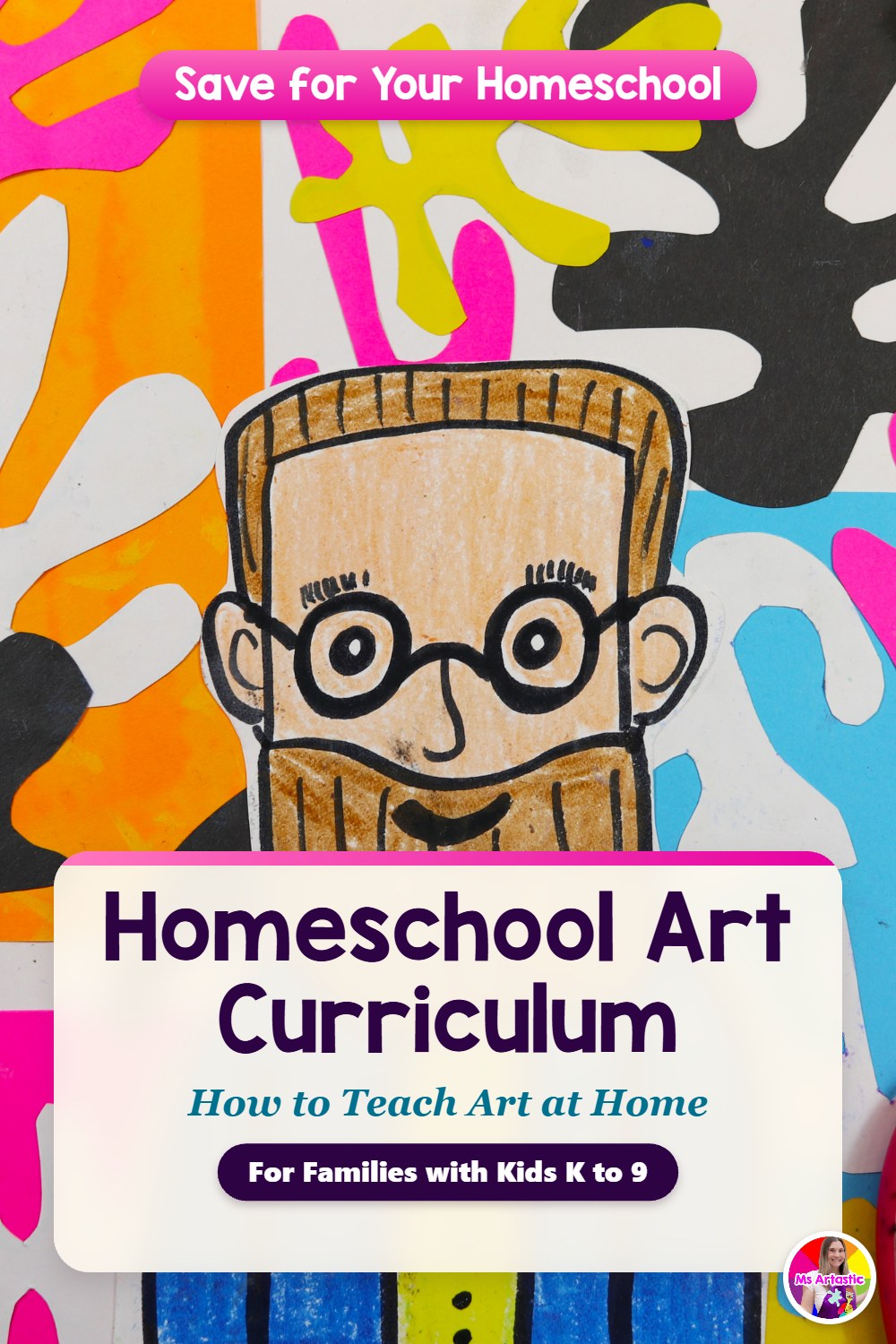
Homeschool Art Curriculum: How to Teach Art at Home
Nov 06, 2026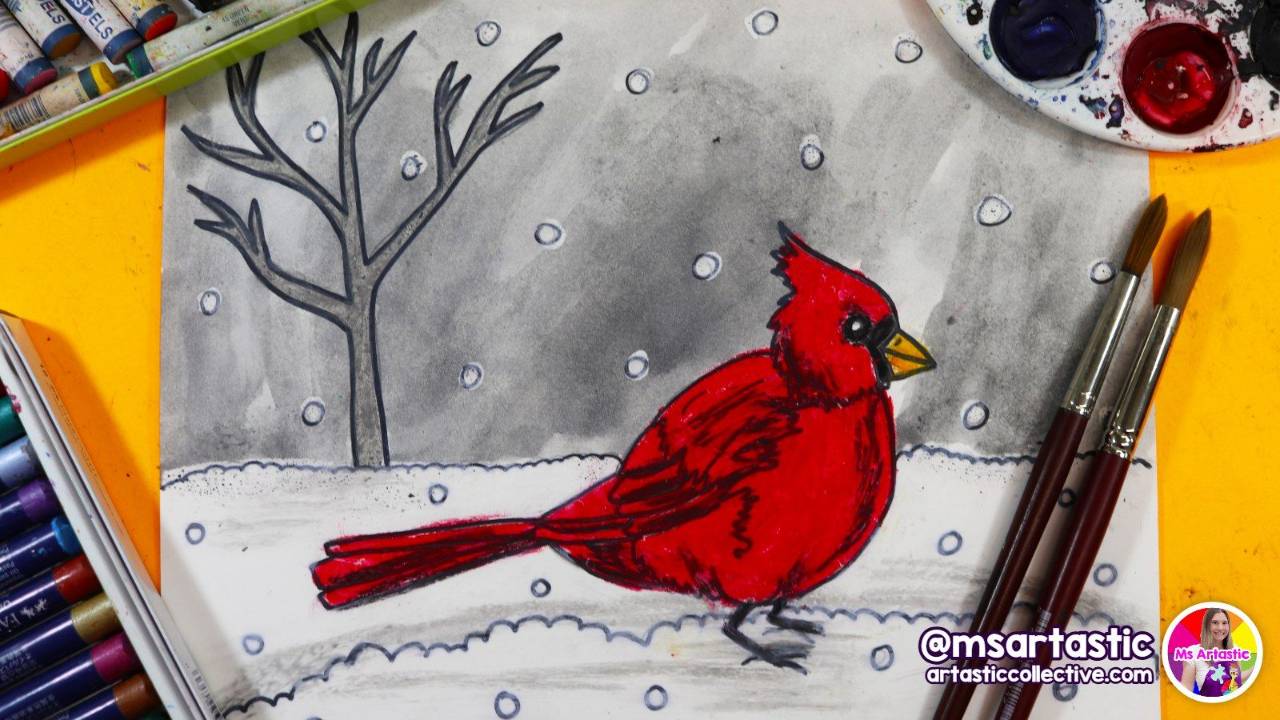
If you are a homeschool parent who loves the idea of art at home but feels a little frozen when it is time to actually teach it, pour yourself a coffee and sit with me for a bit. Choosing a homeschool art curriculum can feel surprisingly big. There are so many options, and most of us did not grow up with a clear picture of what "real" art lessons look like. In this guide I am walking you through how to teach art at home, what to look for in a curriculum, how to teach several ages at the same table, a simple weekly rhythm, the supplies you actually need, and easy ways to see your kids' growth without turning art into a test.
This post contains affiliate links, including links to my own books on Amazon. As an Amazon Associate I earn from qualifying purchases.
I am Kathleen, Ms Artastic. I am an artist and art educator, and I have spent years writing art lessons for art teachers, classroom teachers and homeschool families. The homeschool families I hear from usually want the same three things: lessons their kids are excited about, real skills that build over time, and a plan that does not take over their whole week. That is exactly what we are going to build today.
What to Look For in a Homeschool Art Curriculum
Before you buy anything, it helps to know what a good homeschool art curriculum actually includes. A pile of cute crafts is fun for an afternoon, but it does not teach kids how to see, plan, mix colors or talk about their work. Here is what I would look for, as an art teacher and as someone who writes these lessons.
1. Real art skills that build over time
The backbone of any art program is the elements of art (line, shape, color, value, form, space and texture) and the principles of design (things like balance, contrast, emphasis, movement and pattern). These are the building blocks artists use, and kids can learn them from kindergarten up. A strong curriculum keeps coming back to them, so a five-year-old learning about types of lines grows into a ten-year-old who uses line on purpose to show movement. If you want to see how I teach the principles, my guide to teaching the principles of design to kids walks through each one by grade.
2. Artists and art history
Kids love hearing the stories behind the art. When a lesson is inspired by Vincent van Gogh, Henri Matisse, Wassily Kandinsky or Georgia O'Keeffe, your kids are learning history, culture and vocabulary while they create. Look for lessons that share a little about the artist and then let kids make the idea their own, rather than copying a famous painting line for line.
3. Clear steps you can follow (even if you "can't draw")
This is the big one for most parents. You need a lesson plan, step-by-step visuals, and ideally a video you can press play on. When the steps are clear, you are not the art expert. You are the guide who sets out the supplies, watches the video with your kids, pauses when someone needs a minute, and cheers them on.
4. Flexibility for different ages
Most homeschool families have more than one child, and they are rarely the same age. A curriculum that offers lessons across a wide grade range lets you pick a version that fits each child, or one lesson everyone can do at their own level.
5. Gentle reflection and assessment
You do not need report cards for art at home, but simple reflection pages, artist statements and a rubric help kids notice their own growth. They also give you something to show in a portfolio if your state or province asks for one.
This is the list I kept in front of me when I built the Artastic Collective, my K–9 art curriculum. It is full of lessons on the elements of art, the principles of design, artists and art history, themes, holidays and seasons, and homeschool families use it the same way classroom teachers do: open a lesson, gather the supplies, and teach.
How to Teach Art at Home When You're Not an Artist
Let me say this clearly, friend: you do not have to be "good at art" to teach art at home. Some of the best art time I have seen happens when the grown-up is learning right alongside the kids. Here is how to make teaching art at home feel calm instead of stressful.
Do the project first, or at least watch it. Before your kids start, skim the lesson plan and watch the video (or flip through the step-by-step pages). You will spot the tricky parts, like waiting for paint to dry, and plan for them.
Set up before you call everyone over. Paper, pencils, erasers, the paint cups and a towel ready to go. Art time goes sideways when you are hunting for the black marker while three kids wait.
Use the video as your co-teacher. Press play, pause after each step, and let everyone catch up. Short pauses keep younger kids from feeling rushed and older kids from getting bored.
Talk about the art, not the "talent." Ask questions like "What colors did you choose and why?" or "Which part are you proudest of?" That kind of talk builds confidence much more than "That's beautiful."
Let every artwork look different. If four kids make the same lesson and you get four very different pieces, that is a win. That is creativity showing up.
I wrote a whole post on this over on my main blog, how to teach art when you're not an art teacher, if you want more encouragement. And if video lessons are new to you, my post on how to teach with video art lessons covers pacing, pausing and splitting a project over a few days.
Homeschool Art for Multiple Ages: One Big Idea, Different Levels
This is the question I get most from homeschool families: "How do I teach art to my six-year-old and my twelve-year-old at the same time?" My favorite answer is to share one big idea and let each child work at their own level.
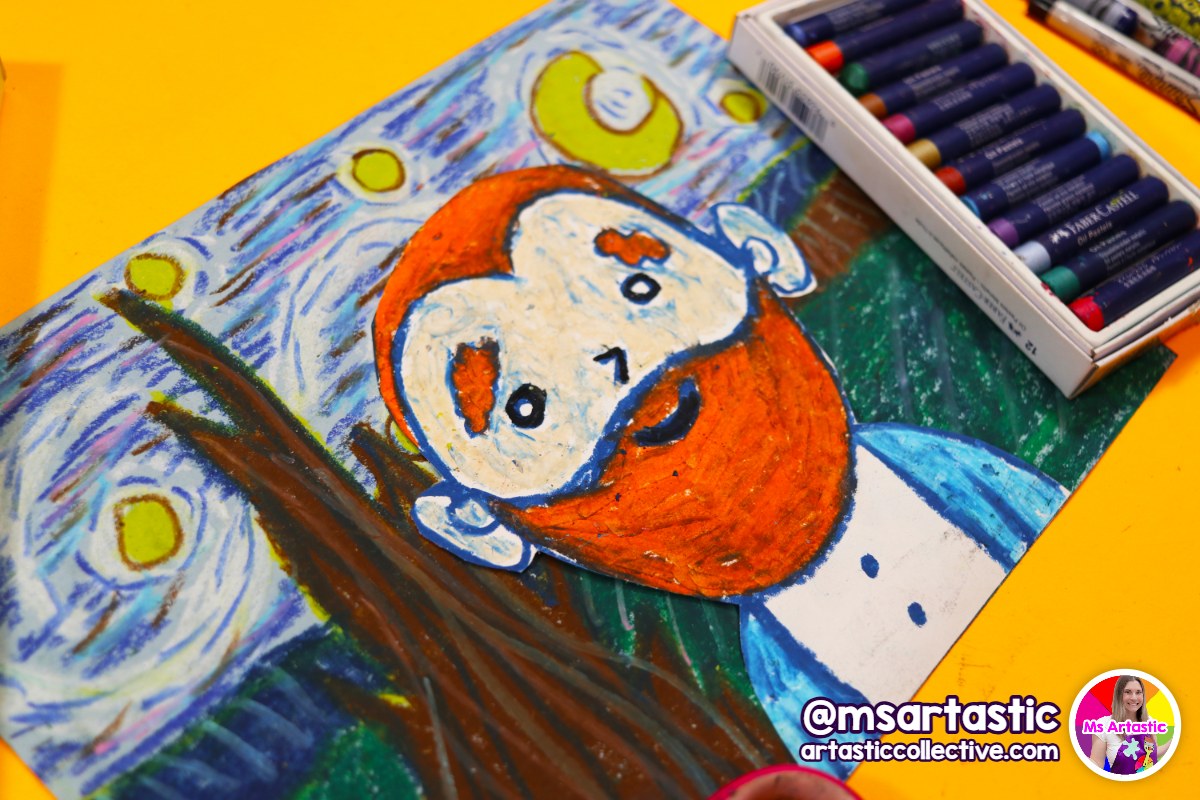
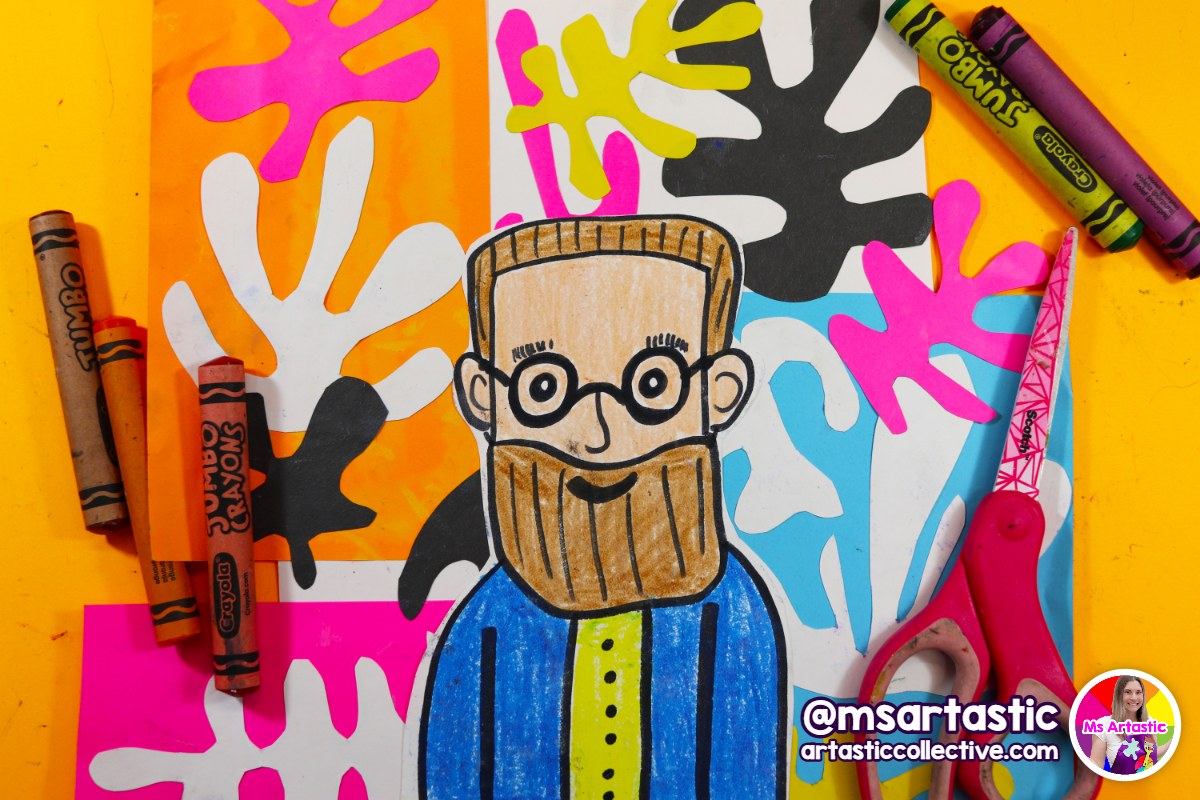
Here is a real example. In the Artastic Collective's artist collection there are lessons inspired by several famous artists, each written for a grade range. Kandinsky's circles are written for grades 1 to 3, the Van Gogh Starry Night portrait for grades 1 to 4, the Matisse cut paper collage portrait for grades 4 to 6, and the Georgia O'Keeffe abstract for grades 6 to 9. You could spend a month on "artists who changed how we see color," and each child gets a lesson that fits them while you all talk about the same big ideas at dinner.
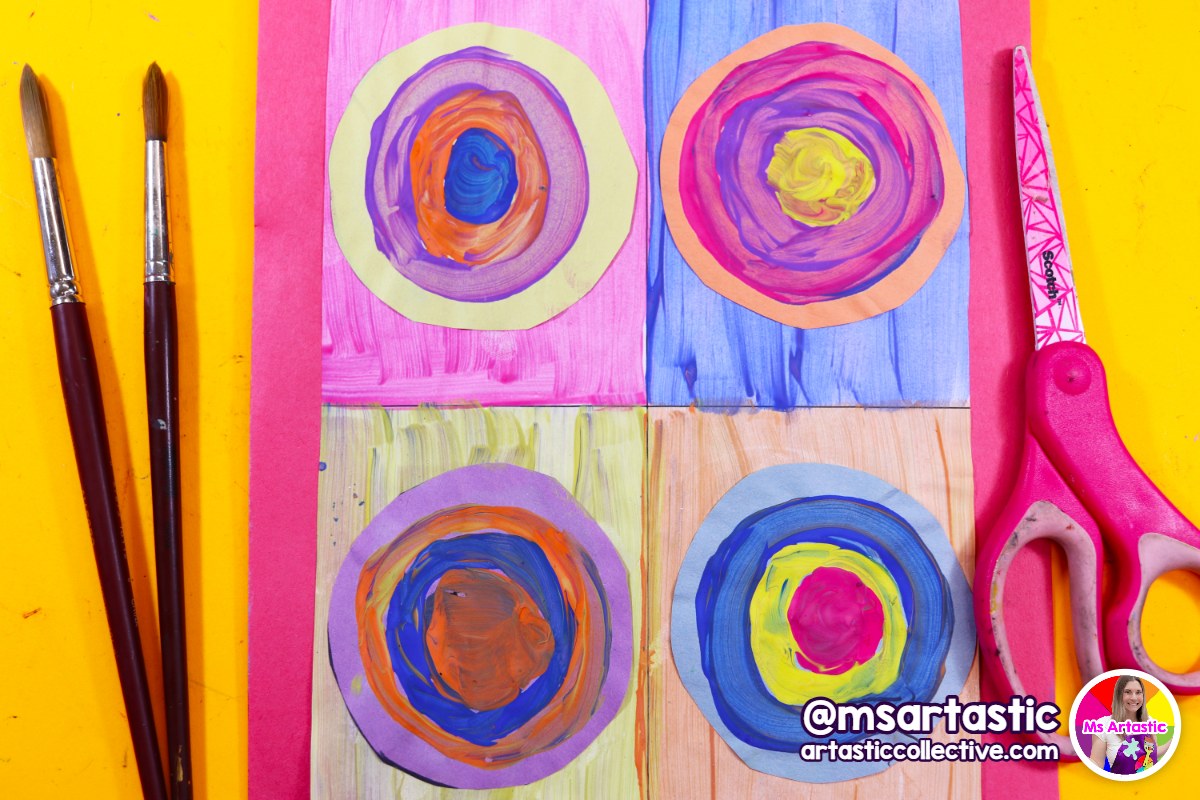
Your little one is exploring color and circles with Kandinsky, while your middle child is building a portrait full of swirling brushstrokes with Van Gogh. Everyone is learning about color and movement, and nobody is bored or overwhelmed.
A few tips for homeschool art with multiple ages:
- Same supplies, different challenge. Put everyone at the table with the same supplies. Younger kids focus on big shapes and bold color; older kids add detail, blending and pattern.
- Let older kids help, a little. Older siblings can hand out supplies or show a younger sibling how to hold an oil pastel on its side. Keep it short so their own art time stays theirs.
- Split long projects. A painting with a dry time works well over two or three short sessions, which suits little attention spans.
- Celebrate the differences. Line up everyone's work at the end and ask each child to point out something they love in a sibling's piece.
I have more ideas in my post on teaching art to mixed ages on msartastic.com, including how to set up a mixed-age art table.
A Simple Homeschool Art Schedule That Actually Works
You do not need art every day. Most homeschool families I talk to do well with one longer art block a week plus a few tiny creative moments in between. Here is a gentle homeschool art schedule you can adjust to your family.
A weekly rhythm
- Day 1, Meet the artist or idea (15 to 20 minutes). Read a picture book, look at a few artworks together, and talk about what you notice.
- Day 2, The main lesson (45 to 60 minutes). Watch the video or follow the steps and start the project.
- Day 3, Finish and add details (30 to 45 minutes). Paint, add pattern, outline, and let it dry.
- Any day, Sketchbook time (10 minutes). A quick drawing prompt with a pencil and a sketchbook.
- End of the week, Share and reflect (10 minutes). Each child shares their art and fills in a short reflection page.
Planning the whole year
Once your weekly rhythm feels comfortable, map out the year. I like to start with the elements of art in the fall, weave in seasonal and holiday lessons as they come up, and spread artist studies across the year so kids meet a new artist every few weeks. If you would like a ready-made plan, my free K–8 art curriculum map lays out a year of art lessons week by week, and my post on how to plan a year of art lessons without getting overwhelmed walks you through doing it yourself.
Explore the Artastic Collective Art Curriculum
What's Included in Every Artastic Collective Lesson
When you are teaching art at home, the materials do a lot of the heavy lifting. Here is what comes with the lessons inside the Artastic Collective, so you can see what "open and teach" really looks like.
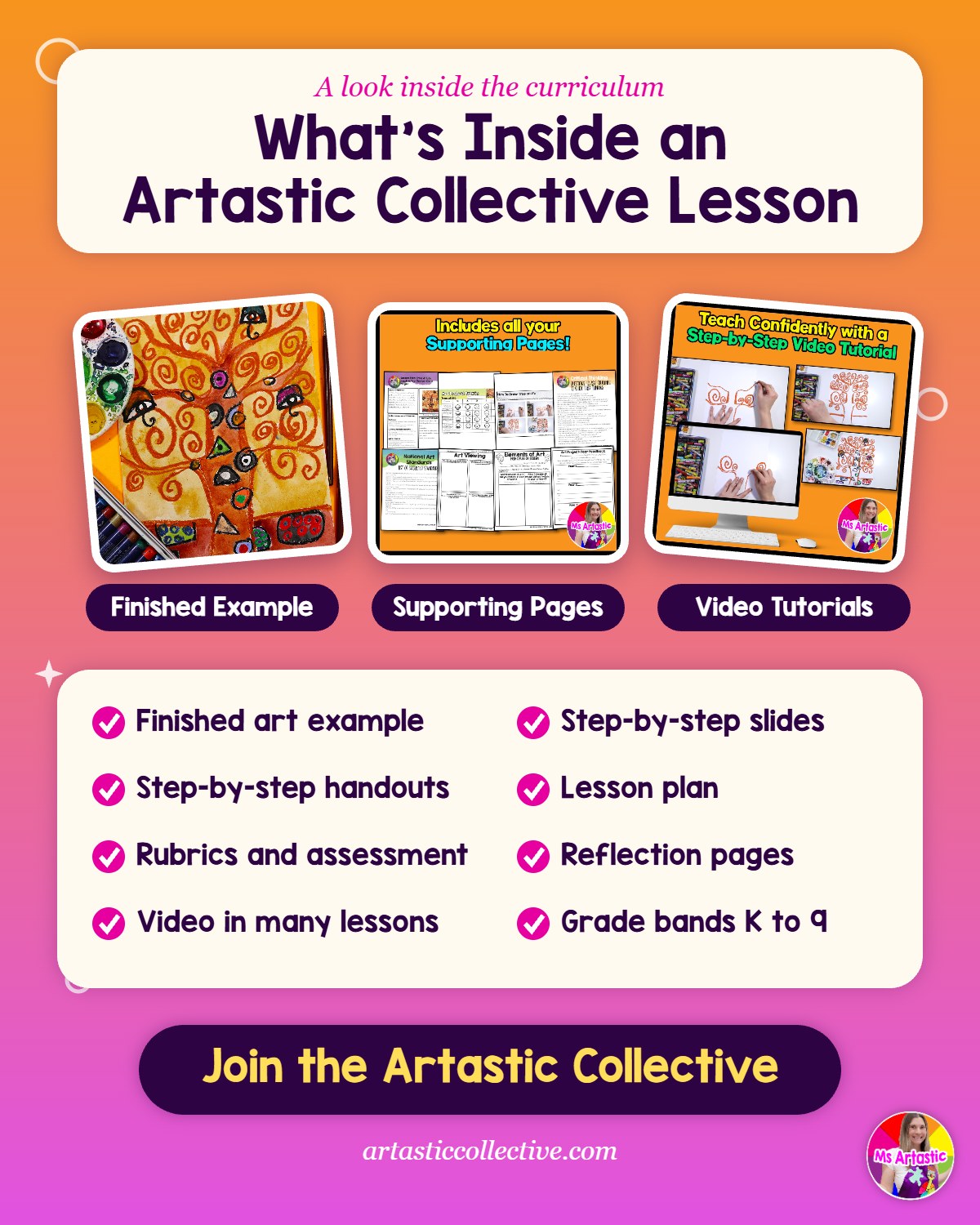
Lessons come with a finished example so your kids can see where they are headed, a lesson plan for you and step-by-step pages or slides, and many include a rubric, reflection pages and an artist statement too. Many lessons also have a full video tutorial where I teach the lesson step by step, so you can press play and create alongside your kids. Not every lesson has a video (some are taught with detailed visual step-by-step pages instead), and each lesson page shows you exactly what it includes.
Art Supplies for Homeschool: A Short, Realistic List
You do not need a craft store's worth of supplies to teach art well. Most of my lessons use a small set of classic materials, and these will carry you through a full year of homeschool art lessons.
- Drawing basics: pencils, good erasers, a ruler and black permanent markers in a couple of thicknesses.
- Color: oil pastels, chalk pastels, colored pencils and washable markers.
- Paint: a watercolor set, a few bottles of tempera paint, and round and flat brushes in a couple of sizes.
- Paper: heavier drawing or watercolor paper for paintings, plain copy paper for practice, and colored construction paper for collage.
- Extras: glue sticks, scissors, a water cup, paper towels and an old shirt for smocks.
- A sketchbook for each child (more on that below).
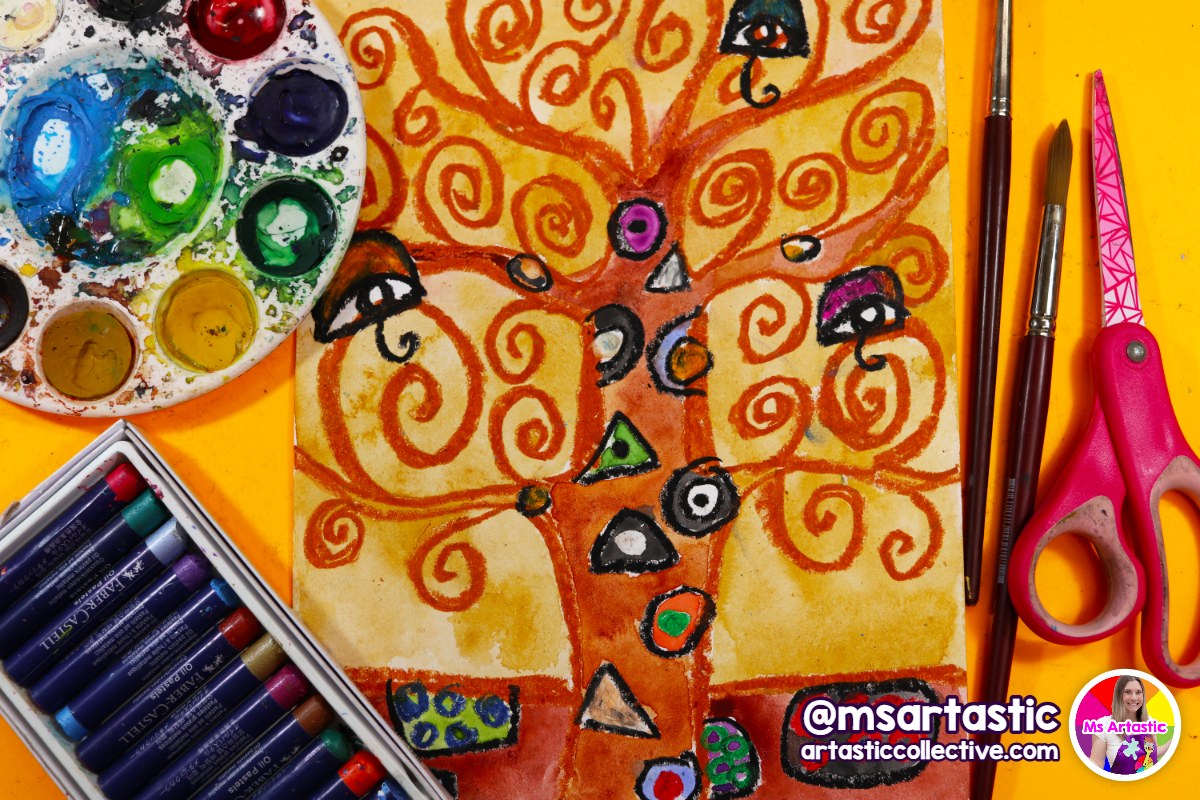
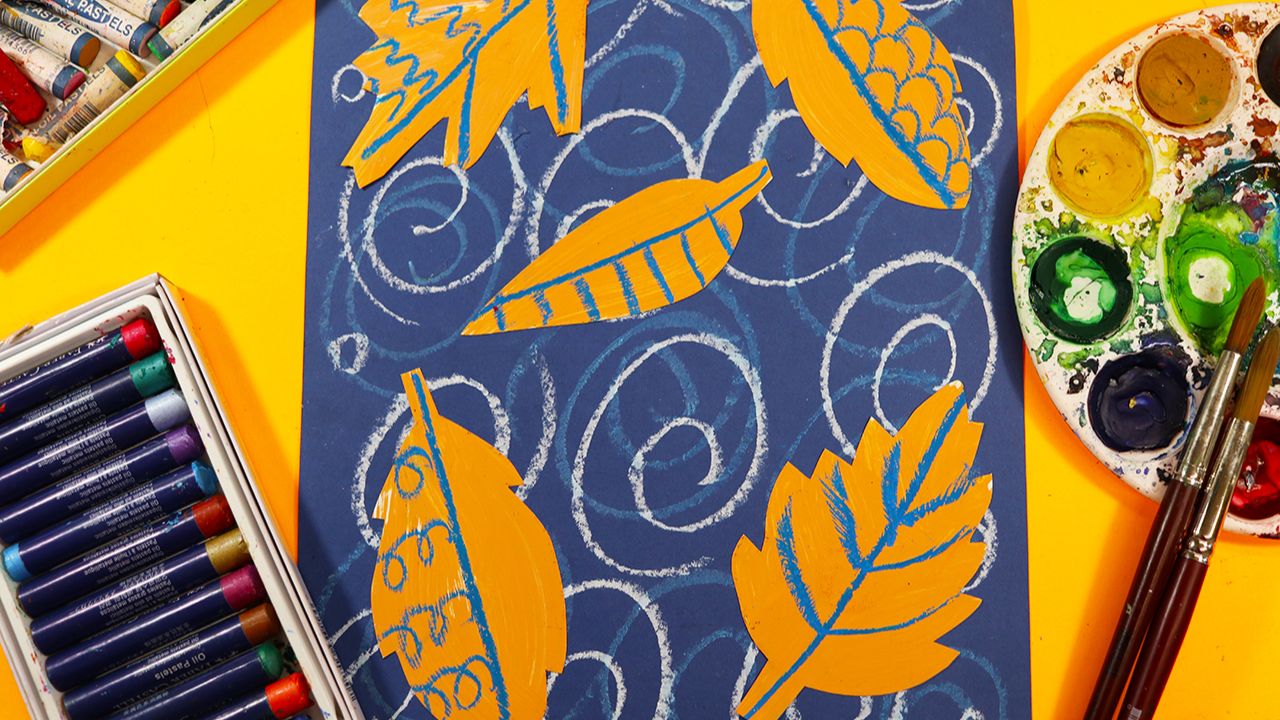
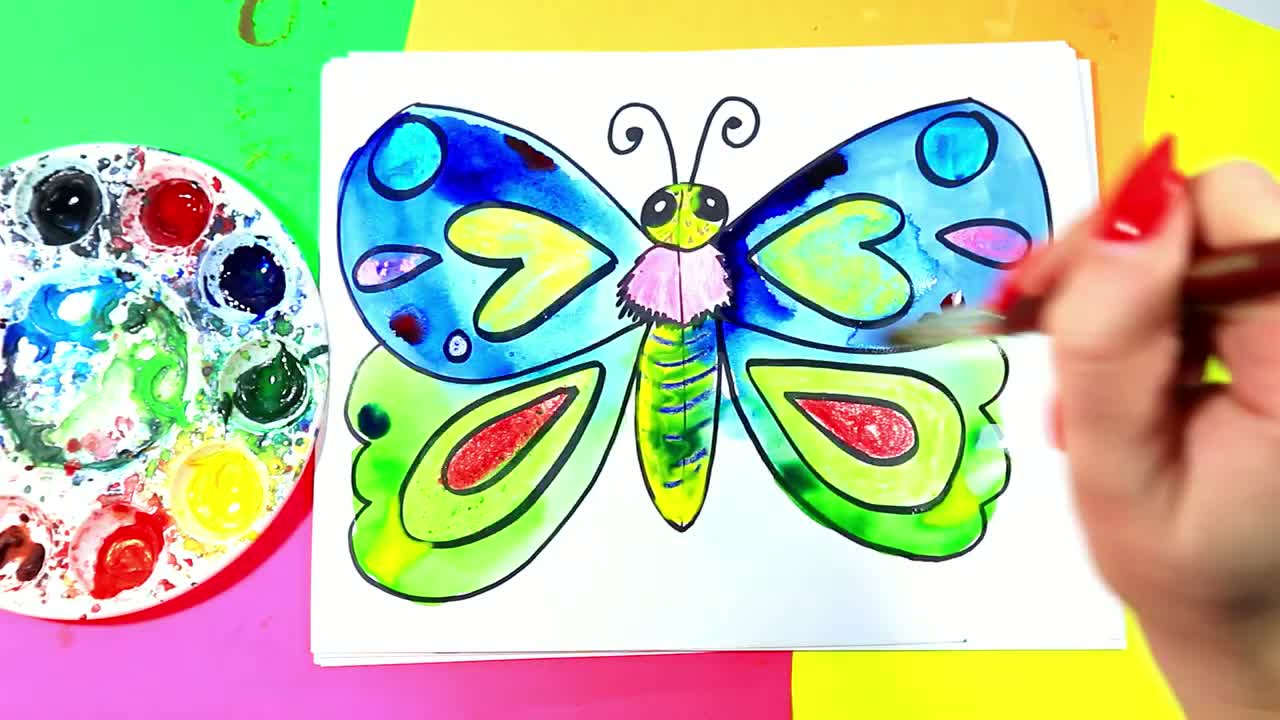
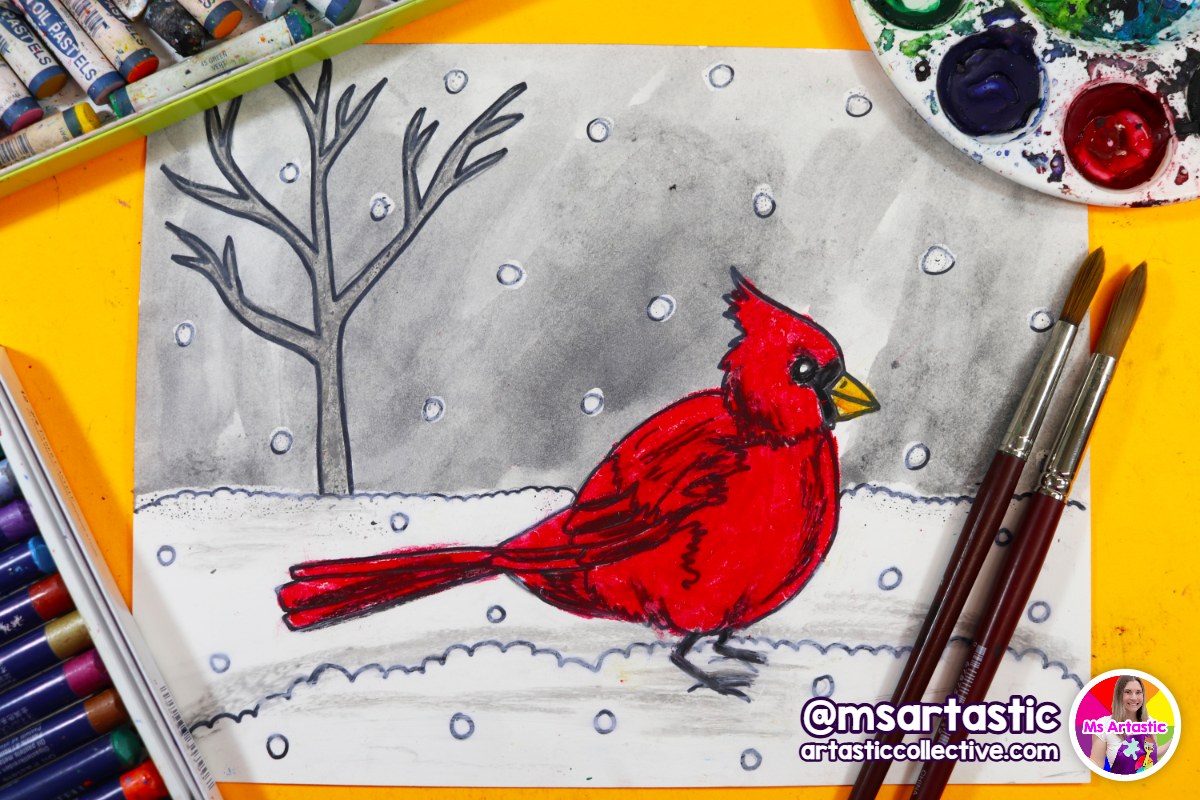
Oil pastels with a watercolor wash over the top is one of my favorite combinations for home, because it works for every age and the results are bright and joyful. If you are watching your budget, my post on organizing art supplies on a tight budget has practical ideas for storing and stretching what you have.
Start a Sketchbook Habit at Home
If I could give every homeschool family one thing, it would be a sketchbook habit. Ten minutes of drawing a few times a week builds observation, confidence and fine motor skills, and it gives kids a place to practice without pressure. Their sketchbook also becomes a lovely record of their year.
The trick is having a prompt ready so nobody stares at a blank page. That is why I made a set of 120 Sketchbook Prompt Task Cards. They are open-ended drawing prompts that work for warm-ups, early finishers and those days when you need a quiet, creative ten minutes. They are free when you join my email list.
Get the Free Sketchbook Task Cards
Pair Your Art Lessons With Picture Books
Picture books are one of the easiest ways to bring art history into a homeschool day. A good read-aloud gets everyone curious before they pick up a pencil. Here are two I love:
- The Noisy Paint Box: The Colors and Sounds of Kandinsky's Abstract Art by Barb Rosenstock, illustrated by Mary GrandPré. It is the story of Wassily Kandinsky and the colors he seemed to hear, and it is a perfect read-aloud before a Kandinsky circles lesson.
- The Dot by Peter H. Reynolds. A story about a girl who believes she can't draw, and the teacher who encourages her to make her mark. I love reading it on the very first day of art at home.
And if you want a whole stack of easy projects for those in-between days, my own book 31 Easy Art Projects for Kids is on Amazon too.
How to See Progress in Homeschool Art (Without Grading Everything)
Assessment at home can be relaxed and still meaningful. Here is what I suggest:
Keep a portfolio. A folder or a big envelope for each child, with the date on the back of every artwork. Flip through it in the spring and you will both be amazed.
Use reflection pages. A few simple questions such as "What did I learn?", "What was tricky?" and "What would I try next time?" help kids think about their process, not just the final piece.
Try an artist statement. Older kids can write a few sentences about their art, the artist who inspired it and the choices they made. It is a lovely way to mix writing and art.
Use a rubric now and then. If you need a record for a portfolio review, a simple rubric shows effort, creativity, skill and process. I explain how mine works in art rubrics for elementary.
Where the Artastic Collective Fits in Your Homeschool
When you are ready for a full homeschool art curriculum instead of piecing lessons together, that is exactly what the Artastic Collective was made for. It is my K–9 art curriculum, with lessons organized by the elements of art, the principles of design, artists and art history, themes, holidays and seasons. You can choose lessons by grade, teach siblings side by side, and lean on the videos and step-by-step pages whenever you need them.
It also means you are not planning alone. Members are welcome in my free Teaching Art Mastermind community too, where teachers and homeschoolers who teach art share ideas, ask questions and join a monthly art challenge.
Not ready for a whole curriculum?
That is completely okay. If you would rather start with a year of lessons you buy once, my Homeschool Art Year: Mixed Ages bundle has 36 lessons, one a month for K to 2, 3 to 5 and 6 to 8, so siblings can make art side by side all year. You can also pick single lessons, like the Van Gogh Starry Night portrait lesson or the Gustav Klimt Tree of Life lesson, and try one at a time.
And if you want to test things out for free first, my Free Art Lesson Library has lessons for back to school, autumn, winter, spring and summer.
Homeschool Art Curriculum FAQ
How often should homeschoolers do art?
Once a week for a longer lesson, plus a couple of short sketchbook sessions, is a lovely rhythm for most families. Consistency matters more than length. A steady weekly art block builds skills much faster than an occasional big craft day.
Can I teach art at home if I can't draw?
Yes. Choose lessons with clear steps and videos, do a quick run-through on your own first, and learn alongside your kids. Your job is to set up, encourage and ask good questions, not to be the most skilled artist in the room.
How do I teach art to kids of different ages at the same time?
Pick one theme or artist and give each child a lesson written for their grade, or use one lesson and adjust the challenge: bold shapes and color for little ones, more detail, blending and pattern for older kids. Everyone shares the same table, the same supplies and the same big ideas.
What should a homeschool art curriculum include?
Look for the elements of art and principles of design, artist and art history lessons, clear lesson plans with step-by-step visuals or videos, lessons across a range of grades, and simple reflection and assessment pages.
What art supplies do I need for homeschool art?
Start with pencils, erasers, black markers, oil pastels, a watercolor set, tempera paint, brushes, good paper and a sketchbook for each child. You can add chalk pastels and collage paper as you go.
You Can Absolutely Do This
Teaching art at home is less about having all the answers and more about making space for creativity, week after week. Start small, pick one lesson, set up the table, and enjoy watching your kids surprise you. If you would like a full plan with everything ready to go, I would love to have you in the Artastic Collective.
Learn More About the Artastic Collective
Want to start for free? Grab my Free Art Lesson Library and try a few lessons with your kids this week.
Get the Free Art Lesson Library
Happy creating,
Kathleen (Ms Artastic)
This post contains affiliate links, including links to my own books on Amazon. As an Amazon Associate I earn from qualifying purchases.
Discover FREE Art Lessons & Resources
Let's Make Some Art! I will create the Art Lessons & Resources, you inspire the kids!
Stay connected with news and updates!
Join our mailing list to receive the latest news and updates from our team.
Don't worry, your information will not be shared.
We hate SPAM. We will never sell your information, for any reason.
Ms Artastic