What Went Well This Year? A Gentle Reflection for Art Teachers
Jun 09, 2026
What Went Well This Year? A Gentle Reflection for Art Teachers
The end of the school year can feel like standing in the middle of an art room after a very enthusiastic paint-and-paper tornado has passed through. There are drying racks to empty, supplies to sort, projects to send home, mystery scraps in places they absolutely should not be, and at least one marker bin that looks like it has given up on life. And somewhere in the middle of all that end-of-year energy, you might be trying to mentally process the year you just taught.
For art teachers, the end of the year is not just about cleaning, organizing, and getting through the last few classes. It is also a time to pause and gently ask, “What went well this year?” Not in a performative, everything-was-perfect kind of way. Not in a way that ignores the hard parts. But in a real, honest, teacher-heart kind of way.
Because even if the year was messy, even if the schedule changed constantly, even if your supplies ran low, even if some lessons took longer than expected, and even if you had moments where you wondered how glitter could possibly travel that far, good things still happened.
Students created.
Students grew.
Students tried.
Students learned.
And you made space for creativity in their lives.
That matters deeply.
Start With the Small Wins
When you reflect on the year, it can be tempting to jump right into what needs to change. Teacher brains are very good at finding the improvements, the adjustments, the “next time I will definitely do this differently” notes. And those reflections are useful. They help us grow.
But before you go there, start with the small wins.
What went well?
Maybe your students became more confident with drawing. Maybe they learned how to use line, shape, color, texture, pattern, or space with more intention. Maybe they finally started slowing down and adding details. Maybe your clean-up routine improved from “tiny chaos parade” to “mostly functional with only a few reminders,” and honestly, that counts.
Maybe your back to school art lessons helped students feel welcome. Maybe your fall art projects created a beautiful hallway display. Maybe your winter art activities brought calm to a busy season. Maybe your spring art lessons helped students reconnect with color, nature, and imagination. Maybe your students fell in love with a project you almost did not teach.
Those small wins are not small at all.
They are evidence that your art curriculum, your routines, your teaching, and your care made an impact.
Notice the Growth That Happened Quietly
Not all growth in the art room is loud.
Sometimes the biggest growth is quiet. It happens when a student stops asking you to draw everything for them and begins trying on their own. It happens when a child who used to crumple their paper after one mistake starts using problem-solving instead. It happens when students begin talking about their artwork with more confidence, more detail, and more ownership.
It happens when a student says, “I’m not done yet,” instead of “I’m done,” after two minutes and one lonely line on the page.
It happens when they start seeing themselves as artists.
This kind of growth might not always fit perfectly into a rubric, but it is one of the most meaningful parts of art education. Yes, we teach techniques, materials, vocabulary, elements of art, principles of design, artist studies, and creative processes. But we are also teaching students how to trust their ideas. We are teaching them how to keep going. We are teaching them that their creative voice matters.
That is powerful.
And if you helped even one student feel more confident creating this year, something went well.
Think About the Lessons That Worked
One of the most helpful end-of-year reflections for art teachers is to think about which lessons truly worked for your students.
Not just which ones looked nice on display, although those beautiful displays deserve their moment too. Think about which lessons helped students feel engaged, successful, challenged, and proud. Think about which projects supported your teaching goals and which ones helped students build real skills.
Which art lessons for kids were easy to teach and meaningful for students?
Which elementary art projects created the best balance of structure and creativity?
Which seasonal art projects were worth repeating?
Which drawing lessons, painting projects, mixed media art lessons, or collage activities helped students build confidence?
Which lessons worked well across multiple classes or grade levels?
These are the lessons you may want to carry forward into next year. They can become anchors in your year-long art curriculum, the dependable projects you know will support student learning and bring joy into your art room.
And if a lesson did not work? That is useful too.
Sometimes a lesson does not need to be thrown away. It just needs clearer steps, fewer materials, more time, a different grade level, or a stronger introduction. Reflection helps you decide what to keep, what to adjust, and what to lovingly retire.
Because not every lesson needs a comeback tour.
Celebrate Your Teaching, Too
This is the part teachers often skip.
You might celebrate your students. You might celebrate their artwork. You might celebrate the successful projects, the beautiful displays, and the creative breakthroughs. But I also want you to celebrate your teaching.
You adapted this year.
You solved problems.
You managed materials.
You guided students through creative decisions.
You answered the same question approximately 800 times and still somehow found the strength to answer it again.
You helped students work through frustration. You encouraged risk-taking. You supported different skill levels, personalities, needs, and learning styles. You created a space where students could try something new.
That is not nothing.
Sometimes art teachers are expected to make everything look joyful and colorful from the outside, even when the inside of the job is a lot of planning, organizing, managing, problem-solving, and emotional labor. Teaching art is beautiful, but it is also work. Real work. Important work.
So when you ask, “What went well this year?” make sure you include yourself in the answer.
You were part of what went well.
Reflect Without Being Hard on Yourself
Reflection should not feel like a meeting with your inner critic.
It should not become a long list of everything you did not finish, every project that went sideways, every display you did not hang, every lesson you wanted to improve, and every moment that made you think, “Well, that was… something.”
Instead, reflection can be gentle. It can be honest without being harsh. It can help you notice what happened, what helped, what felt heavy, what felt joyful, and what you want to carry forward.
You can ask yourself questions like:
What am I proud of from this year?
What helped students feel successful in art?
Which routines made my teaching easier?
Which lessons brought the most joy?
What surprised me?
What would I like to simplify next year?
What do I want students to feel when they enter my art room?
These questions are not meant to create more work. They are meant to help you see the year clearly and kindly.
Because the end of the year is not only a time to evaluate. It is a time to honour what you built.
What Went Well in Your Art Room?
Maybe what went well was a specific project.
Maybe it was your students’ growing independence.
Maybe it was a routine that finally clicked.
Maybe it was your ability to pivot when plans changed.
Maybe it was the way your students responded to a new artist study, a new material, or a new creative challenge.
Maybe it was that your students started using art vocabulary more naturally. Maybe they began noticing color choices, composition, pattern, contrast, or texture in their own work and in the work of others. Maybe they started giving more thoughtful feedback. Maybe they began to understand that art is not just about making something pretty, but about making choices with purpose.
Or maybe what went well was that you made it through.
Some years, that is a real accomplishment.
If this year was challenging, please do not dismiss the fact that you kept showing up. You continued teaching, encouraging, planning, preparing, adapting, and creating opportunities for students. That is something worth recognizing.
Use Reflection to Support Next Year
Once you have noticed what went well, you can use those reflections to gently support your planning for next year.
This does not mean you need to plan the whole year right now. You do not need to map out every single project from September to June while you are still trying to peel tape off the back of student artwork.
But you can leave yourself some helpful notes.
Write down the lessons you want to repeat. Make a note of the projects that need more time. Save the names of materials that worked well. List the routines that helped clean-up, transitions, or early finishers. Record the grade levels that needed more drawing practice, more cutting support, more color mixing, or more opportunities for creative choice.
These notes can become a gift to future you.
Because future you, standing at the edge of a new school year, will be grateful for every little breadcrumb of wisdom you left behind.
Let Next Year Begin With More Support
When you know what went well, you can begin next year with more confidence. You can choose lessons that worked, adjust what needs support, and create a plan that feels more intentional.
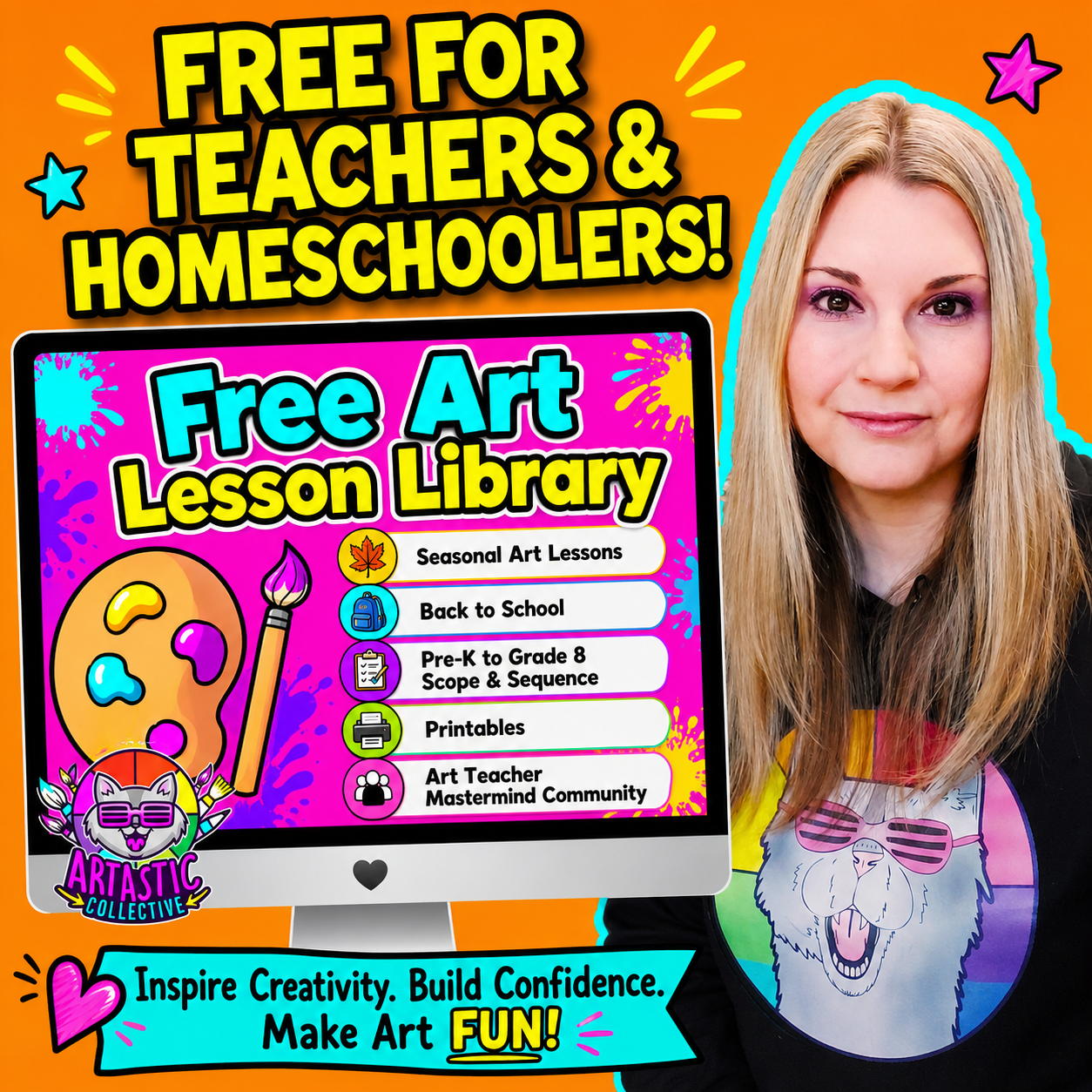
And if you are looking for a gentle place to begin gathering ideas, I would love to invite you to join my email list and explore the free art lesson library.
Inside the free library, you will find free art lessons, seasonal art projects, back to school art resources, art planning tools, and creative ideas to support your teaching throughout the year. It is made for art teachers, classroom teachers, and homeschool families who want meaningful art resources without having to start from scratch every time.
Whether you are reflecting on this year, dreaming into next year, or simply looking for a few ready-to-use creative resources, the free library is there to support you.
You can join and access the free art lesson library by clicking here.
A Gentle Closing Thought
As you wrap up the school year, I hope you give yourself permission to see the good.
Not because everything was easy.
Not because every lesson was perfect.
Not because every student cleaned a paintbrush correctly, because we all know that remains an ongoing journey of hope and mystery.
But because creativity happened in your classroom.
Students made art.
Students practiced skills.
Students expressed ideas.
Students grew in confidence.
And you helped make that possible.
So before you close the door on this school year, take one quiet moment and ask yourself, “What went well?”
Then let yourself answer with kindness.
Sincerely,
Ms Artastic
Discover FREE Art Lessons & Resources
Let's Make Some Art! I will create the Art Lessons & Resources, you inspire the kids!
Stay connected with news and updates!
Join our mailing list to receive the latest news and updates from our team.
Don't worry, your information will not be shared.
We hate SPAM. We will never sell your information, for any reason.
Ms Artastic