End of Year Reflection for Art Teachers: Reflect, Reset, and Plan Your Next Creative Year
Jun 07, 2026
End of Year Reflection for Art Teachers: Reflecting on the Year and Dreaming Into the Next One
There is something very tender about the end of the school year in the art room.
The paint trays are tired. The markers have lived full, dramatic lives. The glue bottles have somehow multiplied and disappeared at the same time. There are half-finished projects tucked into drying racks, mystery paper scraps under tables, and at least one pencil that has clearly been through a heroic journey. And in the middle of all of that beautiful chaos, you are probably standing there thinking, “How did we get here already?”
For art teachers, the end of the year is not just about packing supplies, taking down bulletin boards, or organizing student artwork to send home. It is also a moment to pause and look at the creative growth that happened right in front of you. It is a chance to remember the students who gained confidence, the classes that finally found their rhythm, the projects that surprised you, and the lessons that reminded you why art education matters so deeply.
Because it does matter.
Even when the year was messy. Even when the schedule changed for the 47th time. Even when you had to teach around assemblies, field trips, concerts, testing, snow days, indoor recess energy, and whatever mysterious thing happens to students after spring break. You still made space for creativity. You still helped students see themselves as artists. You still gave them opportunities to think, imagine, problem-solve, reflect, and create.
And that is worth celebrating.
Before You Rush Into Next Year, Let Yourself Look Back
As teachers, we are really good at moving forward. Sometimes too good. We finish one thing and immediately start thinking about what needs to be planned, printed, prepped, cleaned, ordered, fixed, changed, or improved next.
But before you leap into next year’s art curriculum planning, I want you to give yourself permission to look back with kindness.
Not with a giant red pen. Not with a list of everything that went wrong. Not with that teacher brain that loves to whisper, “Well, that could have been better.” Of course it could have been better. Everything can always be adjusted. That does not mean it was not valuable.
Instead, look back like an artist. Look for the layers.
Which art lessons brought the most joy? Which student art projects helped your classes settle into creativity? Which projects taught strong skills in line, shape, color, texture, form, space, value, pattern, or composition? Which lessons helped students talk about their ideas? Which projects helped students build confidence, even if the final artworks were wonderfully wobbly, wildly expressive, or very much “in progress” until the last possible second?
The end of the year is not just a finish line. It is a collection of evidence. Evidence that students learned. Evidence that you adapted. Evidence that creativity grew.
Notice the Growth That Does Not Always Fit on a Rubric
Some of the most meaningful growth in the art room does not always show up neatly in a gradebook.
It is the student who stopped saying, “I’m bad at art,” and started saying, “Can I try again?” It is the class that learned how to clean up without turning the sink area into a tiny water park. It is the child who used to rush through every project but finally slowed down to add details. It is the student who discovered they love painting, or sculpture, or drawing animals, or using pattern, or making the weirdest little character with enormous emotional depth.
That growth matters.
Yes, we teach visual art skills. Yes, we teach the elements of art and principles of design. Yes, we teach technique, process, materials, vocabulary, reflection, and creative problem-solving. But underneath all of that, we are also teaching students how to trust their ideas. We are teaching them that mistakes can become part of the process. We are teaching them that creative thinking is not something reserved for “the art kids.” It belongs to every child.
And when you are tired at the end of the year, it can be easy to forget just how powerful that is.
Ask Yourself What Actually Worked
When you are ready to think about next year, start with what worked.
Not what looked impressive on social media. Not what another teacher is doing. Not what you feel like you “should” be doing because someone somewhere has a perfectly color-coded curriculum map and a storage system that makes you question your life choices.
Start with your real classroom.
What worked for your students? What worked for your schedule? What worked with your materials, your teaching style, your room, your routines, and your energy?
Maybe your students loved directed drawing art lessons because they gave them a confident starting point. Maybe they thrived with mixed media art projects because they could layer materials and make creative choices. Maybe your younger students needed more step-by-step structure, while your older students needed more open-ended options. Maybe your classes needed fewer huge projects and more manageable lessons that could be completed in 2–3 art classes. Maybe your best days happened when you had strong visuals, clear expectations, and enough flexibility for student choice.
These are the kinds of reflections that can shape a more supportive year ahead.
You do not need to reinvent everything. Sometimes the best next step is simply noticing what already helped your students succeed and building from there.
Think About the Year Ahead in Seasons, Skills, and Student Confidence
When you start projecting ideas for next year, it can help to think in three layers: seasons, skills, and student confidence.
The seasonal layer is the one many teachers naturally reach for first. Back to school art projects, fall art lessons, winter art activities, spring art projects, summer art ideas, and holiday or themed lessons can bring beautiful rhythm to the year. Seasonal projects are engaging because students feel connected to the world around them, and they can make your displays feel fresh and joyful.
The skill layer is where your art curriculum becomes stronger. This is where you intentionally build in drawing, painting, collage, printmaking, sculpture, ceramics, art history, artist studies, and the elements of art and principles of design. Instead of planning random projects in isolation, you can begin to think about how each lesson supports student growth over time.
The confidence layer is the one I think we need to protect the most.
Students need art experiences that help them feel capable. They need lessons that are engaging but not overwhelming. They need opportunities to follow steps, make choices, reflect on their work, and develop their own creative voice. A strong year-long art curriculum does not just cover content. It helps students become more confident, independent, and expressive artists.
And that is where your planning becomes more than planning. It becomes care.
Give Future You More Support
One of the kindest things you can do at the end of the year is make a few notes for future you.
Future you will not remember all the tiny details. Future you will forget that one class needed an extra demonstration, that the paint paper worked better than cardstock, that Grade 2 needed more time with cutting, or that Grade 5 absolutely ran with the creative extension and could have used another day.
Write it down now.
Make a short note about which lessons you want to repeat, which ones you want to simplify, which projects would work better earlier or later in the year, and which materials you need to restock. Keep a list of art lesson ideas, seasonal art projects, and art curriculum planning notes that could make next year easier.
This does not need to be fancy. It just needs to be helpful.
Because when August or September rolls around and the back-to-school whirlwind arrives wearing a laminator pouch cape, you will be so grateful for the little breadcrumbs you left yourself.
Planning Next Year Does Not Have to Mean Planning Everything Right Now
Here is your gentle reminder: you do not have to plan the entire next school year before you leave the building.
You are allowed to rest.
You are allowed to close the cabinets, turn off the lights, and let your teacher brain soften for a little while.
But if you are the kind of art teacher who feels calmer when you have a few ideas gathered, then start small. Choose a few strong back to school art lessons. Think about your first month. Gather some free art resources that can support your planning. Make a simple list of themes or skills you want to explore. Let it be enough.
You do not need a perfect year-long plan before summer begins. You just need a starting place.
A supportive plan is better than a perfect plan.
If This Year Felt Hard, You Are Not Alone
Some years feel heavier than others.
Maybe this year you were stretched thin. Maybe you were teaching on a cart, sharing a room, managing huge class sizes, balancing behavior needs, or trying to create meaningful lessons with a budget that looked like it had been attacked by hungry raccoons. Maybe you were covering multiple grades and trying to make sure every student got something valuable from art, even when your schedule was packed and your prep time was almost mythical.
If this year felt hard, that does not mean you failed.
It means you were teaching in real life.
And real life teaching is layered. It is beautiful and exhausting. It is creative and chaotic. It asks a lot from teachers, especially art teachers, who are often expected to make magic happen with limited time, limited space, and materials that may or may not include enough working glue sticks.
So as you reflect, please do not only ask, “What should I improve?”
Also ask, “What did I carry?”
Because you carried a lot. And you still created something meaningful for your students.
A Simple End-of-Year Reflection for Art Teachers
As you wrap up your school year, here are a few gentle reflection questions you can think through in paragraphs, notes, or even just quietly while you clean your room and wonder why there is glitter in a drawer you never opened.
What was my favourite art lesson to teach this year, and why did it work?
Which project helped students feel the most successful?
Which grade level surprised me?
What routines made the biggest difference in my art room?
What lesson would I teach again exactly as it was?
What lesson needs to be simplified, stretched out, or moved to a different time of year?
What skill do I want to focus on more intentionally next year?
What do I want my students to feel when they come into my art room?
That last question might be the most important one.
Because students may not remember every vocabulary word or every project step. But they will remember how it felt to create in your classroom. They will remember if art felt safe, joyful, interesting, meaningful, and possible.
Let Next Year Be Built with Intention, Not Pressure
As you begin thinking about next year, you do not need to chase every idea.
You do not need to do every trend, every theme, every artist study, every medium, every seasonal activity, and every stunning project you see online. That way lies overwhelm, and probably a very suspicious pile of uncut paper.
Instead, build with intention.
Choose art lessons that support student growth. Choose projects that help students practice real visual art skills. Choose activities that make sense for your grade levels, your classroom, your schedule, and your energy. Choose resources that give you structure while still allowing creativity.
A strong art curriculum is not about doing more. It is about creating a thoughtful path for students to grow.
And you deserve support as you build that path.
Start with Free Art Lessons and Planning Support
If you are wrapping up the year and already thinking, “I want next year to feel a little more organized, but I also need it to not eat my entire summer,” I have something that can help.
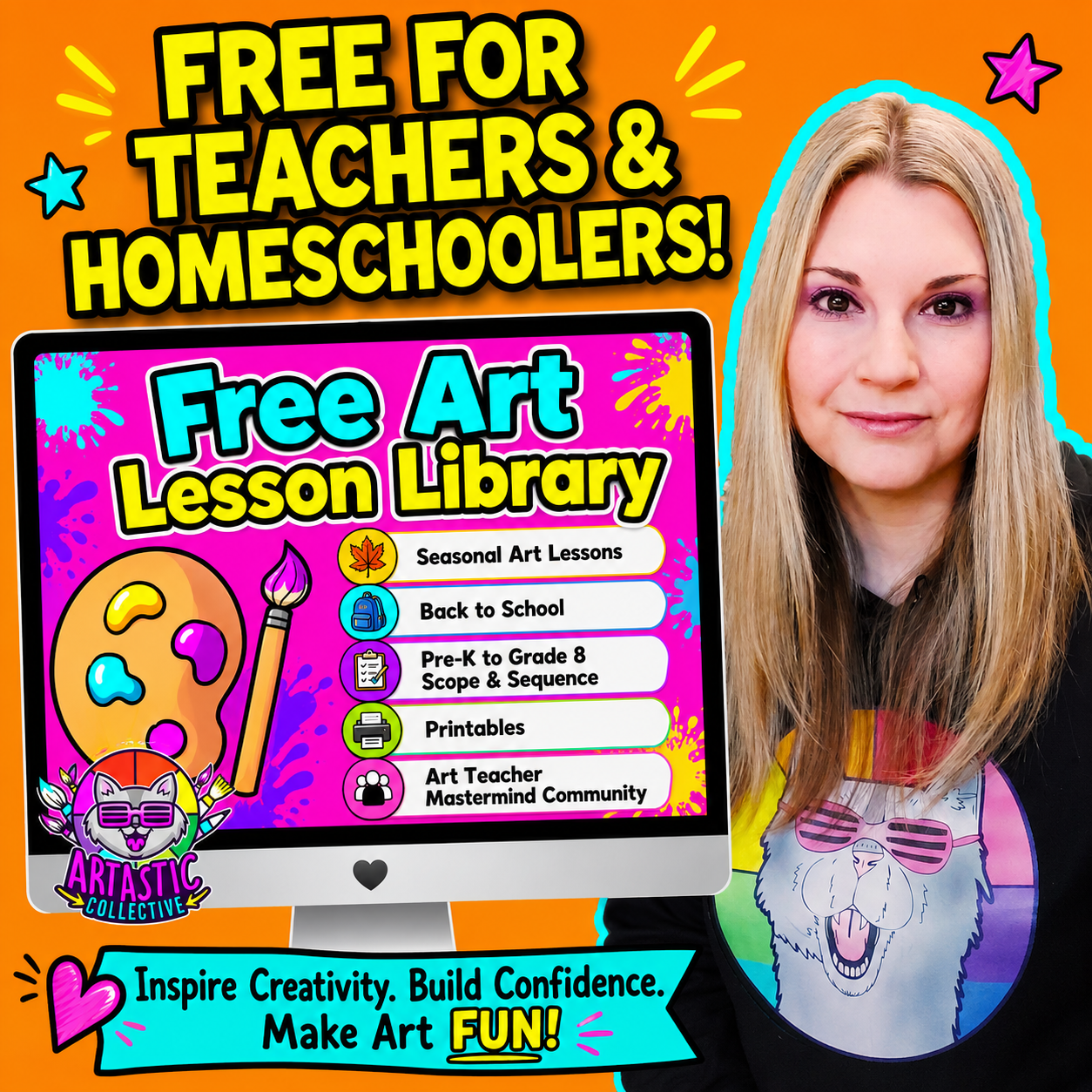
I created a free art lesson library for art teachers, classroom teachers, and homeschool educators who want creative, practical, ready-to-use art resources in one place. Inside, you can explore free art lessons, seasonal art projects, back to school art resources, art planning tools, and creative ideas to support your teaching throughout the year.
It is a simple way to gather inspiration without having to start from scratch. Whether you are looking for a quick art activity, a meaningful visual art lesson, a seasonal project, or planning support for the year ahead, the free art lesson library is there to help you feel a little more prepared and a lot less alone in the planning process.
You can sign up for the free art lesson library here:
CLICK HERE TO GRAB THE FREE ART LESSON LIBRARY
Ending the Year with Pride
As you close out this school year, I hope you take a moment to feel proud.
Not because everything was perfect. Not because every lesson went exactly as planned. Not because every student cleaned a paintbrush properly, because let’s be honest, that may remain one of life’s great mysteries.
Feel proud because you showed up. You taught creativity. You helped students make art, take risks, solve problems, express ideas, and see themselves as artists.
You built something beautiful this year.
And when you are ready, you can begin gathering ideas for the next one. Slowly. Gently. With support. With reflection. With creativity. And hopefully with at least one working glue bottle.
Sincerely,
Ms Artastic
Discover FREE Art Lessons & Resources
Let's Make Some Art! I will create the Art Lessons & Resources, you inspire the kids!
Stay connected with news and updates!
Join our mailing list to receive the latest news and updates from our team.
Don't worry, your information will not be shared.
We hate SPAM. We will never sell your information, for any reason.
Ms Artastic